Home
|
by Jan Lundberg
|
 Frgn. Minister, Marshall Is.
The Paris agreement is essentially a promise to make real promises later.
It is a positive development that the nations of the world agree to try harder (later, as promised). One key improvement over past Conferences of the Parties (COP) is that China (a so-called Developing Nation, even though it is the top emitter) has finally been joined with the U.S. and other Developed Nations, as to taking responsibility.
|
|
|
by Charlene Caprio
|
 [Note: this article was written by Charlene Caprio, Policy and Strategy Consultant for STN/SAIL
MED.]
[Note: this article was written by Charlene Caprio, Policy and Strategy Consultant for STN/SAIL
MED.]
The UN Climate Conference in Paris (COP21) is well underway with positive momentum to adopt a new climate change agreement. The draft Paris agreement calls for parties to keep the global temperature well below 2°C (or below 1.5°C if this language is chosen) above pre-industrial levels. Each party shows how it will do its part by submitting an Intended Nationally Determined Contribution (INDC); 186 parties are represented so far in INDCs. Unfortunately, though, the INDCs fall short of getting us even to 2 °C.
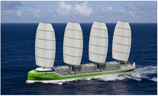
Maritime shipping emissions must be part of the global solution. |
|
|
by Albert Bates
|
 "Sweden has decided to decommission all its nuclear plants but has yet to propose a similar program to phase out its wind turbines."
"Carbon-neutral is so 20th century. We really need to get beyond zero. That is what ecovillages can offer."
We were just concluding a conference call for Global Ecovillage Network delegates in the run-up to the UN climate summit one month from now in Paris when we said that. The discussion had turned to what our message should be. There is a very good program initiated by ten European ecovillages, called the Fossil-Fuel Free Community Challenge. It is very ambitious, and tracks what Sweden, already carbon-neutral, has recently pledged. |
|
|
by Brent Blackwelder
|
|
Publisher's note: The modus operandi of Western Civilization has been expansion at any cost. The leaders and beneficiaries have exploited and oppressed the inferiors--one of whom was Mother Nature who seemed indestructible. Intelligent people have seen the dangers of rampaging industrial development, but seldom see Western Civilization or "growth" as the root issue. Even environmental organizations and "green" leaders put the economy first in their climate protection priorities: relying almost entirely on a technofix for an eventual "clean energy economy" through financing different industries than fossil fuels. Meanwhile, immediate curtailment of energy consumption is far quicker and more effective. We must counteract the inadvertent guardians of the status quo. - J L |
|
|
by Jan Lundberg
|
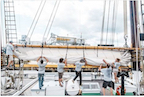 Last month the traditional schooner, Adventure, sailed from Portland, Maine to Boston with 11 tons of local products. It has been many decades since a concerted sail-transport feat like this happened on the New England coast.
Maine Sail Freight is the first significant sail-transport project in two years in the uncrowded sail-transport scene in the U.S. This is still the story of how Northern Europe, with EU support, is running rings around North America in terms of sailing cargo and R&D. There is a new industry for the post-peak oil and greenhouse world, holding much promise for growth. So, one would think the U.S. must not miss the boat. |
|
|
by Richard Adrian Reese
|
 Henry David Thoreau had a mind that was intelligent, complex, and rigidly righteous. He was born in Concord, Massachusetts in 1817, into a family of uppity Unitarian abolitionists. After attending Harvard, he worked as a schoolteacher for a few years. Later, he lived with Ralph Waldo Emerson, serving as a tutor, handyman, and editorial assistant. Emerson took him under his wing, and encouraged his literary efforts. Emerson owned land on Walden Pond, and he allowed the young man to build a cabin there. Living by the pond led to experiences that inspired Thoreau’s classic, Walden.
 |
|
|
by Jan Lundberg
|
 Many believe we have a teetering world economy, even without Greece as an indicator. Now Greece is looming ever larger as a critical if unknown actor. It is mostly considered a bad one, for the entire European, and even the worldwide, financial system and economy. The Greek economy is approaching an almost unprecedented standstill. For clear reasons it probably will never get back to a "normal" or desirable level of consumption. When stepping back from witnessing the daily crisis, it would appear timely to ask what are the real factors in the big picture? Was the crisis brought on just by second-rate policies combined with inefficiency, corruption, and oppression?
 |
|
|
by Jan Lundberg
|
 Pico, Azores
Another successful round-trip voyage from The Netherlands to the Caribbean is coming to a close. The star example of zero-carbon shipping, the 32-meter brigantine Tres Hombres cargo sailing ship has made good progress across the Atlantic, and has left the Azores going northeast. |
|
|
by Jan Lundberg
|
Introduction
I was thinking about a friend who got a decent job recently. In the minds of billions of people, it would seem to solve his problems for meeting his obligations. Though entry level, it’s a desirable job where the workplace is pleasant. I began to reflect on his being a proud member of the working class, and how his path (however reluctant or exhilarating) generally follows middle class aspiration. It is extremely unlikely that someone in his position manages to join the exalted, glitzy, rich, tiny segment of the population, to enjoy the dream of the very easy life -- not that his value-system pushes him in that questionable direction.
Unfortunately, he is probably boxed in at the lower middle of the social pyramid, because another, very different path for working people and even the rich is not so visible or tempting. |
|
|
by Jan Lundberg
|
|
Review with author interview
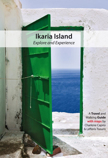
Ikaria Island: Explore and Experience
A Travel and Walking Guide with Maps
by Charlene Caprio and Lefteris Tsouris
2015, Wooden Hull Press, USA
If exploring natural environments and traditional cultures are up your alley, this book is for you. You will feel like thanking two energetic young people who, with sensibility – not just the pull of adventure or business – made the effort to reveal and honor a unique, small part of the world. |
|
|
by Allan Stromfeldt Christensen
|
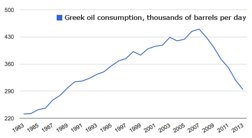
Over the past couple of months the story keeping many people on the edge of their seats has been the ongoing dilemma of Greece's detested debt burden, its Great Depression-worthy 25% contraction of its economy, and its voluntary or even forced withdrawal from the eurozone – the fabled "Grexit."
For about five years now, heavy austerity policies (cutbacks in government spending) have contributed to what is being described by some as a "humanitarian crisis." |
|
|
by Jan Lundberg
|
|
Urban dwellers experience a familiar hum caused mainly by motor vehicles, along with other sounds of modern civilization: buildings' heating and air conditioning, power tools, aircraft, and, arguably least objectionable, the voices of people and animals. Other urban background cannot be heard but is seen, smelled and, to some, felt: air pollution and electronic waves. The often murky air along with light-pollution assures that seeing many stars is unlikely, and is of little concern anyway to the typical technological urbanite.
This background is almost unnoticeable to those inured to it, such that it is only upon leaving and coming back that one perceives the discolor of the sky and the lack of silence in the city and suburbs.
|
|
| << Start < Prev 1 . 2 . 3 . 4 . 5 . 6 . 7 . 8 . 9 . 10 . Next > End >>
|
|
|
|




